Hypothesis
|
|
Daily flow fluctuations at Glen Canyon Dam dry (desiccate) and kill aquatic insect eggs laid in the evening along the shorelines resulting in population level declines or absence in the abundance and diversity of aquatic macroinvertebrates (midges and EPT) below the dam and into Grand Canyon.
- In areas where evening egg laying is out of sync with the daily hydropower wave (Glen Canyon, Upper and Lower Granite Gorge), we should be able to detect increased egg laying and egg survival during the low weekend flow.
- Increased egg survival should translate into increased larval and adult insect abundance and diversity.
|
How will we know if Bugflows are successful?
|
- Increase in catch rates of aquatic insects (midges, mayflies, caddisflies, stoneflies, etc.)
- See a smoothing of the spatial pattern in midges in Grand Canyon
- See catch distribution of EPT that is less tied to tributary confluences.
- Increase in a greater variety of aquatic insects in the mainstem including EPT like mayflies, caddisflies, and stoneflies
|
Observations
|
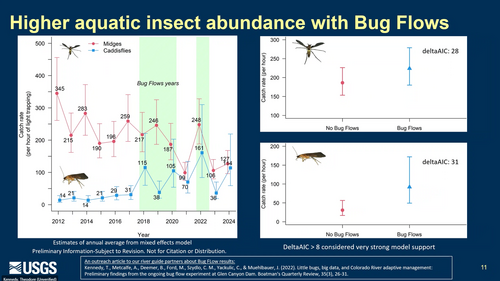 2025 Annual Reporting Meeting - The abundance of two types of caddisflies (Hydroptilids and Hydropsychids) increased riverwide in three of four years that Bug Flows were conducted compared to the pre-Bug Flow baseline from 2012-2017. Caddisflies have been present but rare in Grand Canyon and improving conditions for them was a primary objective of the experiment. However, this caddisfly increase is correlated with years with low suspended sediment levels, complicating this response.
- Contrary to predictions, no increases were seen in other EPT species like mayflies or stoneflies. Mayflies in particular are found in many types of rivers and have a broad range of habitat tolerances. Their absence from the mainstem continues to be puzzling.
- Contrary to predictions, no increases in the abundance or changes in distribution in midges were observed across multiple long-term datasets. Modeling suggested that a ~30% increase and a smoothing of midge distribution riverwide might be realized if Bug Flows was successful.
- More adult aquatic insects emerged from the Colorado River riverwide during steady weekend Bug Flows compared to weekday fluctuating releases, suggesting that low steady flows somehow prompt emergence of adult insects.
- Bug Flows increased algae production by 38% in Marble and Grand Canyon, resulting in an additional 100 metric tons of algae-carbon to sustain food webs. The increase in algae production during Bug Flows was energetically substantial and likely supported increased invertebrate and fish production.
- The types of prey eaten by rainbow trout in Glen Canyon varied by flow treatment but overall energy intake was unchanged. Anglers captured rainbow trout at a higher rate during the steady weekend flows than during regular weekday fluctuating flows.
|
How are Bugflows monitored?
|
|
|
LTEMP descriptions
|
|
A more diverse and productive aquatic food base could benefit a variety of priority
resources, including native fish (including the endangered humpback chub), the rainbow trout
fishery, and other riparian species that occur in Glen, Marble, and Grand Canyons. Mayflies
(Ephemeroptera), stoneflies (Plecoptera), and caddisflies (Trichoptera), collectively referred to as
EPT, are important components of a healthy aquatic food base, but they are notably absent from
the Glen and Marble Canyon reaches and very low in abundance and diversity in the Grand
Canyon. GCMRC has hypothesized that EPT taxa are recruitment limited, because daily flow
fluctuations to meet hydropower demand cause high egg mortality, and the absence of EPT has
an adverse effect on the carrying capacity and condition of the trout fishery and native fish
communities. EPT are thought to be recruitment limited because Glen Canyon Dam fluctuations
create a large varial (intermittently wetted) zone along shorelines. Because the Colorado River in
Glen, Marble, and Grand Canyons is canyon-bound and the tributaries that join the river all have
comparatively low flow, the size of the varial zone does not appreciably decrease with distance
downstream. Thus, although water temperature regimes become more naturalized with distance
downstream, the effect that daily flow fluctuations to meet hydropower demand have on the
stability of shoreline habitat does not attenuate much with distance from the dam.
This hypothesis attributes the absence of EPT and the poor health of the invertebrate
assemblage to the width of the varial zone, similar to earlier investigations (Blinn et al. 1995),
but focuses on the effects unstable shorelines have on the eggs of these species. This hypothesis
assumes that egg-laying by EPT occurs principally along shorelines. According to the
hypothesis, EPT taxa downstream of Glen Canyon Dam are recruitment limited, because daily
flow fluctuations to meet hydropower demand negatively affect habitat quality along the
shorelines where egg laying is assumed to occur.
To test this hypothesis, macroinvertebrate production flows would be provided every
weekend from May through August (34 days total). The flow on weekends would be held
steady at the minimum flow for that month, which would ensure that the insect eggs laid during
weekends would remain submerged throughout larval development. If the hypothesis is true,
there would be an increase in insect production due to the reproductive success of insects that
laid eggs during weekends. No change in monthly volumes, ramping rates, or the maximum
daily range in flow during weekdays would be required for this experiment. To offset the smaller
water releases that would occur during weekends within a given month, larger releases would
need to occur during the weekdays within a given month.
Implementation of macroinvertebrate production flows would consider resource
condition assessments and resource concerns using the processes described in Sections 2.2.4.3
and 2.2.4.4. These flows may not be tested when there appears to be the potential for
unacceptable impacts on the resources listed in Section 2.2.4.3.
Effects of the tests would be evaluated using observation to determine the location where
insect eggs are deposited and the emergence rates of species. Depending on the outcome of the
tests, the experiment could be discontinued if there were unacceptable effects on other resources.
There is also the possibility that implementation would result in confounding interactions with
TMF experiments, and this will be discussed during the communication and consultation process
as described in Section 2.2.4.4.
Target two to three replicates (Table 2-9, Page 2-54).
Low steady weekend flows (“Macroinvertebrate Production Flows”) would be conducted to test whether the
flows would increase insect abundance. On an experimental basis, for example,
flows would be held low and steady for two days per week (weekends) from May
through August to attempt to improve the productivity of the aquatic food base,
and increase the diversity and abundance of mayflies (Ephemeroptera), stoneflies
(Plecoptera), and caddisflies (Trichoptera), which are collectively referred to as
EPT.
|
|
Information and Links
|
|
Drift and Food Availability Studies
|
Resources that might be affected
|
- Foodbase: abundance, diversity, availability (drift)
- Hydropower: value, capacity
- Trout and native fisheries: production, condition
- Lees Ferry fishery: access, economics
- Boater safety: Glen Canyon, downstream
- Sediment transport: beaches
|
Financial costs of the experiment
|
- The cost of the 2018 Bugflow Experiment was $165,000 [2]
- The cost of the 2019 Bugflow Experiment was $327,000 [3]
- The cost of the 2020 Bugflow Experiment was $941,000 (3)
The three-year (2018-2020) total of doing the Bugflow Experiment is $1,433,000
- The cost estimate for doing a Bugflow Experiment in 2021 (which wasn't implemented) was $1,021,000
- The cost of the 2022 Bugflow Experiment was $1,154,000 [4]
|
Possible confounding factors
|
- Tributary inflows make mainstem flows anything but "steady" through Grand Canyon
- Changes in nutrients, turbidity, and temperature are also thought to be strong drivers of macroinvertebrate production
- Bugflows may have a compounding affect on production that may not be seen for many bug generations (months to years)
|
Papers and Presentations
|
|
2026
2023
2022
2021
2020
2019
2018
2016
|
Other Stuff
|
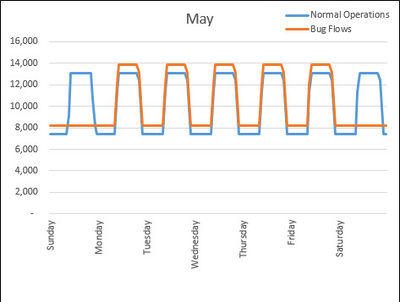 Example of an experimental Macroinvertebrate Production Flow (MPF) hydrograph Modeling Assumptions:
- Macroinvertebrate Production Flows (MPFs) would occur every weekend from May - Aug (34 days, we scheduled July to have the 5th weekend because that how it works out in 2016)
- Weekend flow = minimum flow for the month = weekday minimum flow (see weekly hydrographs on the monthly tabs)
- Hybrid Public Draft monthly volume, ramp rates, or daily change parameters
- Moved weekend water to weekday releases
- Energy prices used in this modeling are for a Saturday, Sunday, and a weekday for May, June, July, and August 2016. These are the energy prices Argonne used in the LTEMP modeling for 2016.
Hybrid Public Draft 8.23 MAF volumes:
- May = 632
- June = 663
- July = 749
- August = 800
Ramp rates: 4,000 up and 2,500 down
Daily change:
- May = 9
- June = 10
- July = 10
- August = 10
Minimum release: 5,000 cfs
Maximum release: 25,000 cfs
|
|


